
Introduction: A Future Worth Building
When we imagine the future, it’s often painted in shades of gray—grim dystopias ruled by mega-corporations, ecological collapse, or cold, lifeless cities driven by AI. But what if the future looked radically different? What if it were green, decentralized, community-powered, and beautiful? That’s the promise of solarpunk: a genre, aesthetic, and socio-political movement that dares to imagine a world where both people and the planet thrive. Rooted in environmentalism, social justice, and practical optimism, solarpunk envisions a future that works—because it has to. And more importantly, it shows us how to get there.
What Exactly Is Solarpunk?
Politically, solarpunk often aligns with eco-socialist, anarchist, and anti-capitalist ideals. It critiques extractive systems of power and instead envisions decentralized, community-led structures built on mutual aid, ecological stewardship, and collective resilience. While not all solarpunk creators or communities share the same political identity, the movement generally challenges hierarchies that prioritize profit over people and the planet.
In this way, solarpunk is difficult to pin down because it’s not just a style or story—it’s a framework for the future. It spans literature, fashion, architecture, activism, gardening, and even DIY engineering. At its core, solarpunk embraces optimism in the face of climate anxiety, promotes decentralized systems and local solutions, and emphasizes sustainable technology that enhances rather than exploits life. It values diversity, community, and mutual aid. As Adam Flynn wrote in Solarpunk: Notes toward a manifesto, solarpunk is “a movement in speculative fiction, art, fashion, and activism that seeks to answer and embody the question ‘what does a sustainable civilization look like, and how can we get there?’” He emphasized that solarpunk is “optimistic, at times radically so,” and exists as “a counterpoint to cyberpunk, a way to repoliticize the notion of futurism.” Solarpunk asks: What would a future look like in which we solve the climate crisis, rather than merely survive it?
A Brief History of the Solarpunk Movement
The origin of the term “solarpunk” traces back to a 2008 blog post titled From Steampunk to Solarpunk, where an anonymous writer envisioned a new genre of speculative fiction. Inspired by the MS Beluga Skysails—a pioneering vessel partially powered by a computer-controlled kite—the blog post proposed a shift from the retro-futurism of steampunk to a forward-thinking aesthetic centered on clean technology and practical sustainability. This early articulation framed solarpunk as both a cultural reaction to climate and energy crises and a creative prompt for imagining livable, decentralized futures.
In 2009, literary publicist Matt Staggs published the “GreenPunk Manifesto” on his blog, outlining a vision for a new speculative fiction genre grounded in do-it-yourself sustainability, ethical technology, and ecological balance. Though distinct from solarpunk, GreenPunk shared many of the same concerns and ideals, emphasizing a hands-on approach to positive environmental change through technophilic, grassroots innovation.
In the same year, artist Olivia Louise posted influential concept art on Tumblr that brought the solarpunk aesthetic vividly to life. Her work, featuring stained-glass solar panels, art nouveau flourishes, and lush greenery entwined with futuristic cityscapes, helped crystallize the visual identity of solarpunk for a broader audience.
A turning point came in 2014 with Adam Flynn’s Solarpunk: Notes toward a manifesto, which distilled solarpunk’s core ideas and aesthetics. The momentum continued to build across disciplines, influencing everything from architecture to game design.
In 2024, solarpunk received formal recognition in The Encyclopedia of Science Fiction, where James Machell highlighted its lineage through earlier works such as Norman Spinrad’s Songs from the Stars (1980) (Buy on Bookshop.org) —A philosophical tale of post-technological renewal and planetary stewardship, which Machell identified as the first text in the subgenre. He contrasted solarpunk with cyberpunk, stating, “It is a rebellion against a rebellion, born out of dystopia fatigue.”
Other foundational novels include Ursula K. Le Guin’s Always Coming Home (1985) (Buy on Bookshop.org) – a future ethnography blending poetry, ecology, and anarchism in a reimagined California; and The Dispossessed (1974) (Buy on Bookshop.org) – a story of a physicist navigating two radically different planets in an exploration of anarchism and capitalist critique.
Becky Chambers’ Monk & Robot series—beginning with A Psalm for the Wild-Built (2021) (Buy on Bookshop.org) and followed by A Prayer for the Crown-Shy (2022) (Buy on Bookshop.org)—has been embraced as a quintessential solarpunk narrative. These quiet, contemplative novellas follow a tea monk named Dex and a robot named Mosscap as they journey through a pastoral, solar-powered world where technology and nature coexist peacefully. These books don’t focus on conflict or catastrophe but instead celebrate curiosity, self-sufficiency, and the emotional resilience of living lightly on the Earth.
Visualizing Solarpunk
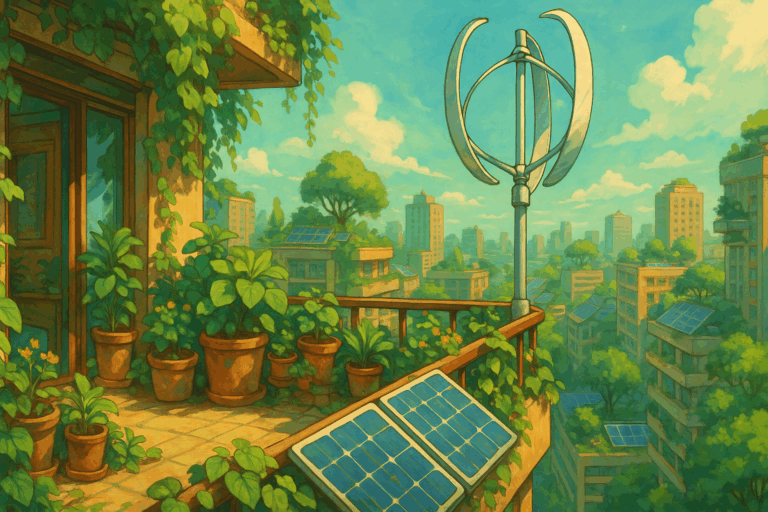
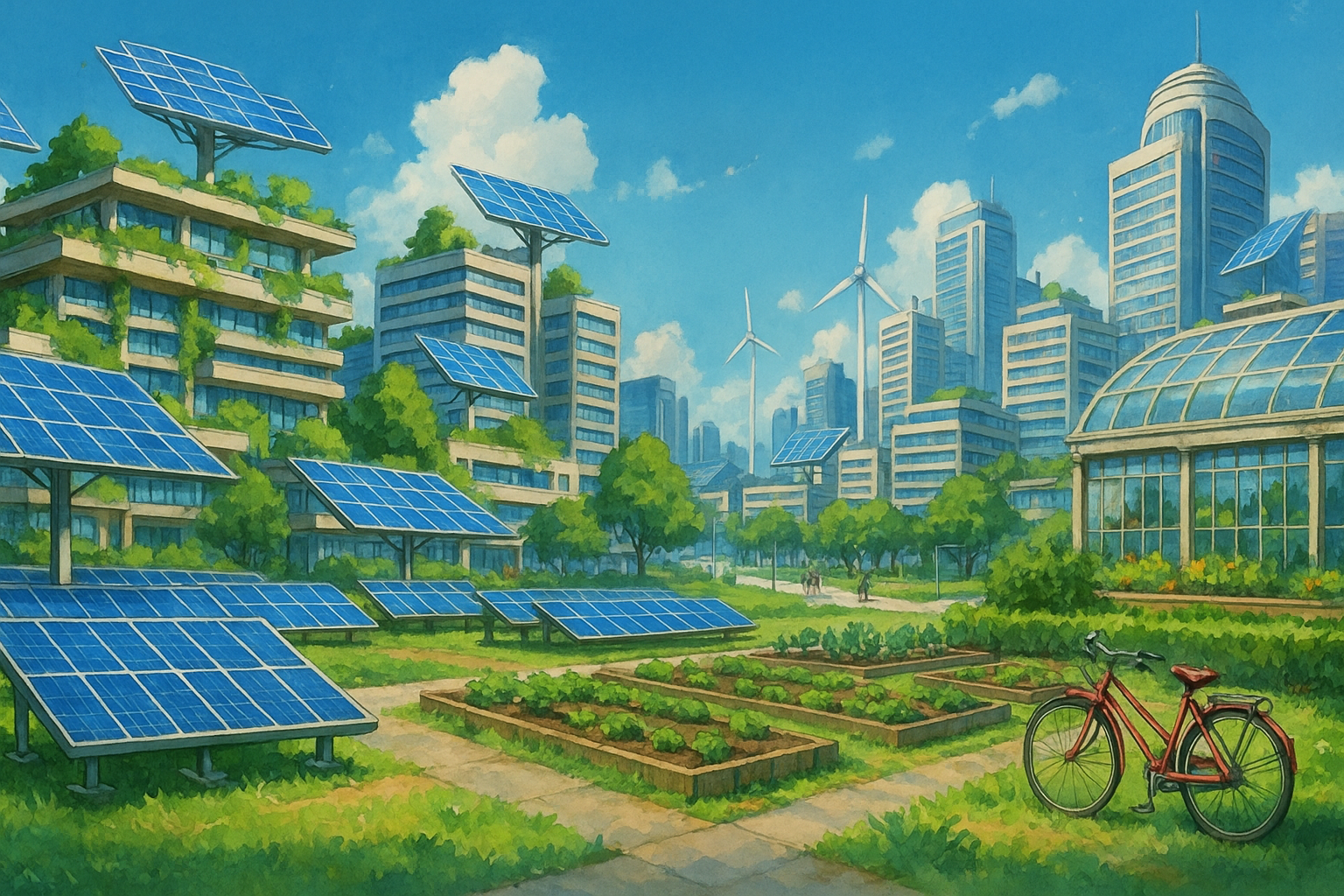
Visually, solarpunk is striking. Imagine lush rooftop gardens on art deco high-rises, solar-powered homes with decentralized energy grids, and public spaces filled with edible landscaping and community co-ops. Homes are built from recycled materials and powered by the sun. Fashion is crafted from natural fibers, homes from reclaimed materials, and communities from shared effort. Nature is not something to be conquered—it’s interwoven with every aspect of life. Solarpunk blends high tech with low impact, where innovation harmonizes with sustainability. As writer and designer Adam Flynn noted in Solarpunk: Notes toward a manifesto, solarpunk is about “a world that is both high-tech and ecologically sound.”
For a visual overview, the short video Dear Alice (made as an ad for Chobani yogurt) beautifully explores the movement’s values, architecture, and visual identity.
Solarpunk in Action
While solarpunk may have started as a speculative genre, it’s increasingly real. Across the globe, small and large-scale initiatives are proving the solarpunk ethos is achievable. In cities like New York and Tokyo, microfarms are turning rooftops into food hubs.
These systems allow year-round growing with minimal space and water use, making them ideal for densely populated environments where green space is limited. Community-owned solar grids are sprouting across rural towns and urban neighborhoods, reducing dependency on monopolized utilities and offering clean, reliable power. Many households are replacing plastic-based sponges with biodegradable loofahs and reusable cloths—simple yet meaningful changes that reflect solarpunk values. Ecovillages and cooperative housing projects demonstrate how shared resources and communal spaces can foster stronger, more resilient societies.
To see how solarpunk values can be applied in the context of urban resistance and direct action, read our companion piece: Solarpunks Give a F**k: A Guide to Urban Rebellion.
Challenges Ahead
Optimism doesn’t mean ignoring the obstacles. Solarpunk recognizes the very real challenges ahead: corporate resistance to decentralization, regulatory red tape that limits local energy independence, and access inequality for clean technology and green infrastructure. Greenwashing is also a concern, with companies marketing themselves as sustainable while continuing to use unsustainable materials. Solarpunk is not naïve—it’s defiant. It isn’t about wishing things were better—it’s about building the future anyway, even when it’s hard. As author and futurist Kim Stanley Robinson observed, “It’s crucial to be hopeful and brave. That’s the only way to make any progress.”
How to Live Solarpunk Now
You don’t have to wait for the future to live solarpunk. Even small changes can have a significant impact. Grow something—even a single herb on a windowsill connects you to your food. Switch to natural materials like loofah sponges, bamboo toothbrushes, and linen fabrics to reduce plastic waste and microplastic pollution. Install a micro solar panel to power small devices independently. Use a microfiber filter bag or lint filter when doing laundry to stop plastic microfibers from entering waterways. Buy secondhand clothing—one of the greenest actions you can take. Solarpunk is also about connection—build community by joining local timebanks, tool libraries, or community gardens.
Hope Is a Technology
Solarpunk is more than a mood or a genre—it’s a survival mechanism. In a world running out of time, it reminds us we still have choices. The future can be bright, leafy, and solar-powered—not because it’s easy, but because it’s necessary. And maybe, just maybe, we want it to be beautiful too.
The seeds of that world are already in our hands. All we need to do is plant them.
References:
Republic of the Bees. (2008). From Steampunk to Solarpunk. https://republicofthebees.blogspot.com/2008/04/from-steampunk-to-solarpunk.html
Staggs, M. (2009). GreenPunk Manifesto.
Flynn, A. (2014). Solarpunk: Notes toward a manifesto.
Ulibarri, S. (Ed.). (2018). Glass and Gardens: Solarpunk Summers. World Weaver Press.
Spinrad, N. (1980). Songs from the Stars.
Le Guin, U. K. (1985). Always Coming Home.
Le Guin, U. K. (1974). The Dispossessed.
Chambers, B. (2021). A Psalm for the Wild-Built.
Chambers, B. (2022). A Prayer for the Crown-Shy.